
Points versus Percentages
Is one better than the other?
When the market dropped by over a thousand points on Monday, there was a lot of talk about how it was one of the biggest drops in history. If someone is trying to promote some kind of narrative about why the market is doing so terribly (I can think of at least one potential political figure that some individuals might want to pin the blame on), then using points can make the drop seem truly historic.
From a points perspective, saying the drop is one of the biggest ever isn’t wrong but it is certainly misleading. That’s because, literal no one analyzing the stock market from a logical point of view would ever use points for historical comparisons. Historical comparisons require the use of percentages.
Imagine if the Dow fell 340 points tomorrow. Not a huge deal right? Except, that’s how much the Dow fell between September 3, 1929 and July 8, 1932 and people call that period the Great Depression because the market dropped from 381.2 to 41.2, or -89.1%, and it made everyone depressed. That’s just one quick example showing why points don’t really work when making long-term historical comparisons.
Points aren’t useless though. They are actually super helpful when used for short-term comparisons. Here is an example:
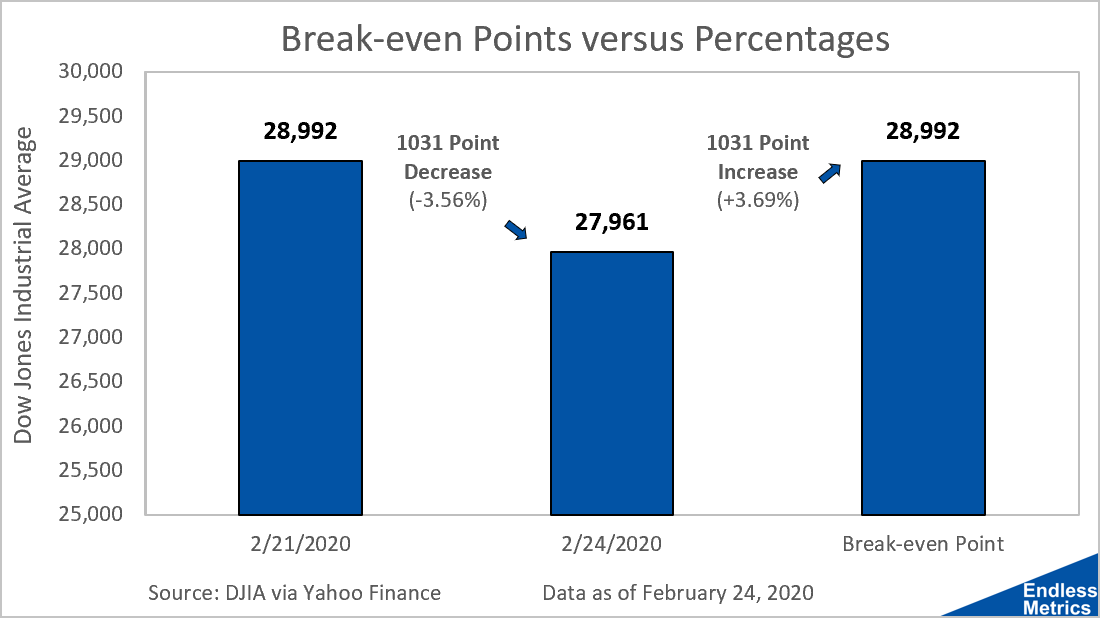
If the market falls by some amount of points, then it is very easy to know what the break-even point is - it’s a rise of the same number of points! It’s really easy to think in this manner because when there is a drop, people want to quickly know what needs to happen for them to get all their money back.
Take percentages for the short-term case in the chart above. The market fell -3.56%. But, +3.56% won’t be enough to get back to break-even. It will need to be an increase of +3.69%. If you can do that kind of math like it is no big deal than all the power to you. Most people are like me - dumb. So, points are the way to go.
In summary, use points in the short-term to make life easier. Use percentages for long-term comparisons or risk making ridiculously deceptive statements. Unless you have an agenda - then do whatever you want I guess. Just know that the stuffy economists will be laughing at you from their ivory towers and calling your analysis “misleading.”