
Stocks and Recessions
Timing the market
Investors put their money into companies based on their future earning potential. Because of this, generally speaking, the stock market is forward looking.
Stocks don’t do well during recessions because economic activity contracts and companies make less money and consumers spend less and people lose their jobs and basically things just aren’t very fun. But, if stocks are forward looking, then how early might they price in recessions?
To answer this, I took the average S&P 500 return during months of recession going back to 1872. I then took leading and lagging monthly returns and looked at those averages. Here is what the results look like:
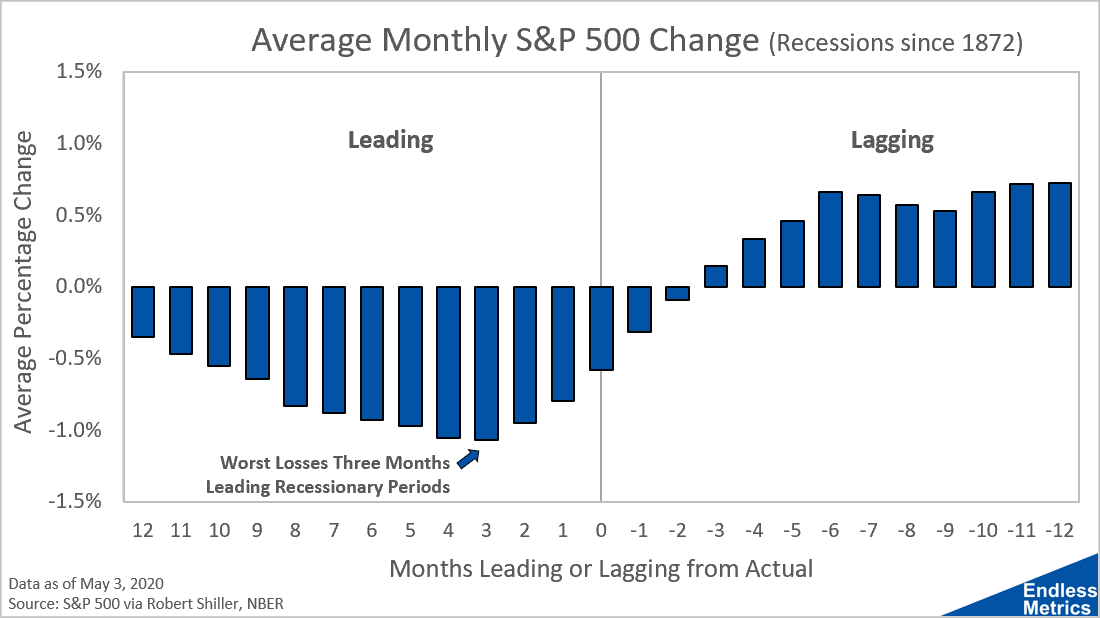
If you average the monthly change in the S&P 500 during months that the economy is in a recession, you see negative returns. This is seen on the chart at point zero. It makes sense - stocks should go down on average during an economic contraction.
To see if stocks are a leading indicator though, you can offset the monthly changes. For example, if October of one year is in recession, instead of averaging the monthly S&P 500 change for October you average it for September. When you do that, you see point one on the chart and there are slightly bigger losses on average.
This phenomenon of increasing leading losses peaks at three months, suggesting that stocks look forward about a quarter. This is consistent when comparing stocks and GDP. So, the result makes sense.
During the last recession, stocks hit their bottom in March of 2009, three months before the end of the recession in June 2009. This is just one cherry picked example but shows at least some additional evidence to support the idea.
Looking forward, what might this imply about our current situation? Well, if stocks bottomed in March this could suggest an end to the recession by June or July. That’s a big if - and if not, expect to see some more pain in the market.