
Inflation
Prices and toasters
The previous post covered real and nominal GDP, which both measure the economic output of the economy. One measure accounts for inflation and the other does not. So, let’s talk a little about inflation and look at one of the most popular ways to measure it - the consumer price index (“CPI”):
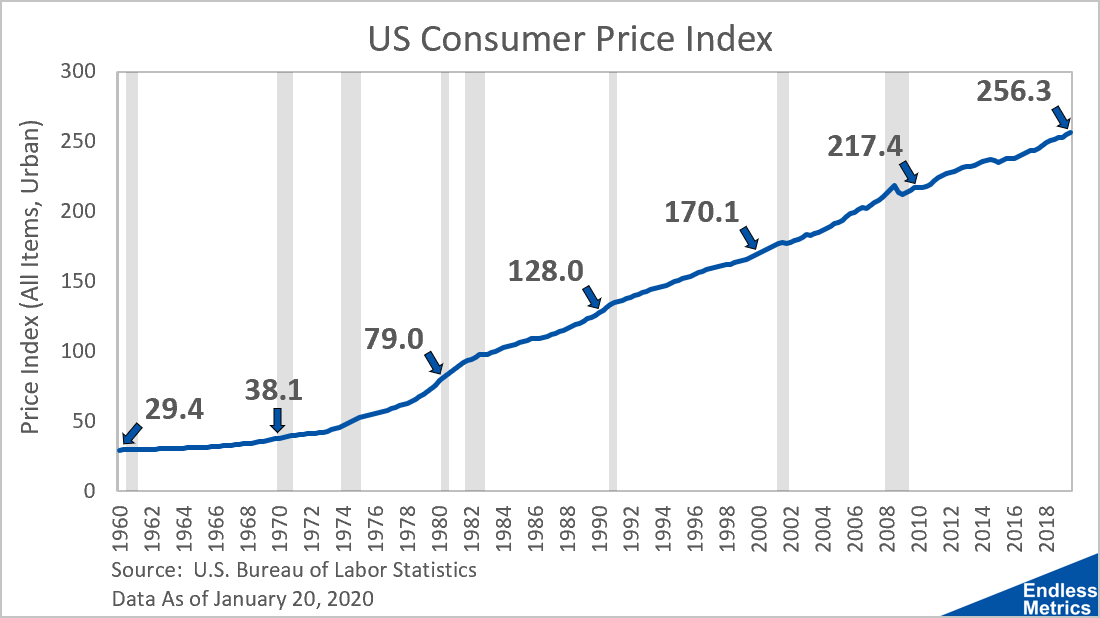
The consumer price index is, to explain very simply, a collection of a wide range of prices for things sampled over time. So, every month economists bother people and say, “Hey, how much does this thing cost this month?” and the person replies “well this thing changed a little bit” and then economists just keep asking every month until eventually people lose their minds but the result is this really cool line above.
The CPI index creates a very powerful tool that can compare the price of things over time. I think this is best explained with an example. Let’s take the recent reading of 256.3. If we compare that to 1990, which has a value of 128.0, and take the ratio by dividing 256.3 by 128.0 we get 2.0. This value of 2.0 means that, in aggregate, it would take about twice as many dollars to buy things with today’s dollars than dollars from 1990. Ten dollars is ten dollars but what that ten dollars can buy changes. Maybe a toaster cost 50 dollars in 1990 but that same toaster would be 100 dollars today. The reason for this is inflation. Things get more expensive over time.
Now, this change isn’t always reflected just in price. You might say, well I actually got a toaster for cheaper than it cost in 1990! It could be that, for some goods, they do get cheaper over time. Or, the toaster today is not as of good quality as the one in 1990. Remember, the CPI looks at things in aggregate so there is a range of different outcomes on an individual product-by-product basis.
Consider a burger off the dollar menu at a fast food joint. You can get a burger for a dollar today just as you could get a burger for a dollar in 1990. But, the burger today probably isn’t as big. Same goes for candy bars. A lot of popular brands have kept the same price but made their product smaller to compensate. So, there are a lot of factors at play. It’s complicated! Economists do their best to account for all these things and, generally, the aggregate works out to be incredibly useful despite the complex nature of the underlying phenomenon.
I’ll cover inflation in more detail down the line but I wanted to just briefly cover it now as it is such an important economic driver and the key difference between nominal and real GDP. In the next few posts, I’ll go back to GDP with more of a focus on the real aspect of things - but don’t forget about inflation as this will definitely not be its last mention!
Related content:
What’s Next for Endless Metrics